
SAP's AI Push: Next-Gen, BTP, and the Race to the Autonomous Enterprise
SAP just changed its org chart. That might sound like inside-baseball, but the bigger story is what it signals about how SAP wants every enterprise running on its software to use AI.
Why a Reorg Is the Right Place to Start
In July 2026, SAP split its product and engineering organization into two power centers, and the split tells you exactly where the company is placing its bets:
- Business AI Platform — led by CTO Philipp Herzig, bringing together data and analytics, platform and AI, and what used to be the standalone SAP Business Technology Platform (BTP) organization, all under one roof.
- Autonomous Suite — led by Manoj Swaminathan, unifying core applications across finance and spend management, supply chain, HR, customer experience, and cloud ERP into a single delivery organization.
Both leaders report to CEO Christian Klein during the transition. That structure is not cosmetic — it mirrors a real shift in strategy: from AI as a feature bolted onto individual applications to AI as a layer that runs across business processes. Everything downstream in this post — Next-Gen Ariba, BTP, Joule — is SAP building the plumbing to make that shift real.
The Bigger Vision: The Autonomous Enterprise
At SAP Sapphire 2026, Klein put a name to where this is heading: the Autonomous Enterprise — “where agents run the business and you can focus on what truly matters.” It has two connected halves:
- The SAP Business AI Platform is where agents get built, contextualized, and governed. SAP describes it as three layers: a context layer (pulling in SAP and non-SAP data through SAP Business Data Cloud and a SAP Knowledge Graph, so agents aren’t reasoning over broken or siloed data), a build layer (Joule Studio, now at version 2.0, where customers and partners design agents for specific outcomes), and a governance layer (controls to keep agents accurate, compliant, and auditable).
- The Autonomous Suite sits on top of that platform and is where the AI actually does the work — SAP says it will span more than 50 domain-specific Joule Assistants across finance, supply chain, procurement, HR, and customer experience, each one orchestrating a slice of 200+ specialized agents.
This is why the org chart matters: Herzig’s team owns the platform layer that makes agents trustworthy, and Swaminathan’s team owns the application layer where those agents actually touch your invoices, your suppliers, and your close process.
And SAP isn’t just talking concept — it’s citing real numbers from early deployments: an 83% reduction in invoice cycle time (IBM), greater than 99% billing accuracy (Amadeus), and a 98% reduction in time to reconcile ICT postings. Those are the kinds of outcomes the rest of this post is about preparing your organization to capture.
Where “Next-Gen” Fits Into This
If the Autonomous Enterprise is the destination, SAP Next-Gen is what SAP calls the concrete, shipping step toward it. You’ll see the term used two ways:
1. Technology: Next-Gen SAP Ariba on BTP. This is the flagship example of the Autonomous Suite in action today. Next-gen Ariba is a ground-up rebuild of SAP’s source-to-pay platform, moved off its legacy multi-tenant stack and onto BTP. It launched its first release (2602) in February 2026 and is rolling out incrementally through 2026 and 2027. Rather than bolting AI onto an old system, SAP re-architected the platform so intelligence sits at the core of every workflow — sourcing, contracts, invoicing, supplier management, and buying.
2. People: SAP Next-Gen Student Programs. SAP also uses “Next-Gen” for talent initiatives like the Career Ignite Student Program, connecting final- and penultimate-year students with SAP technologies through workshops and partners like Google, Capgemini, and Ericsson — building the workforce that will eventually run these AI-driven systems.
Both threads point to the same underlying shift described above: SAP is betting its future on AI embedded in the platform layer, not as an add-on.
The Building Blocks, Now Under One Roof
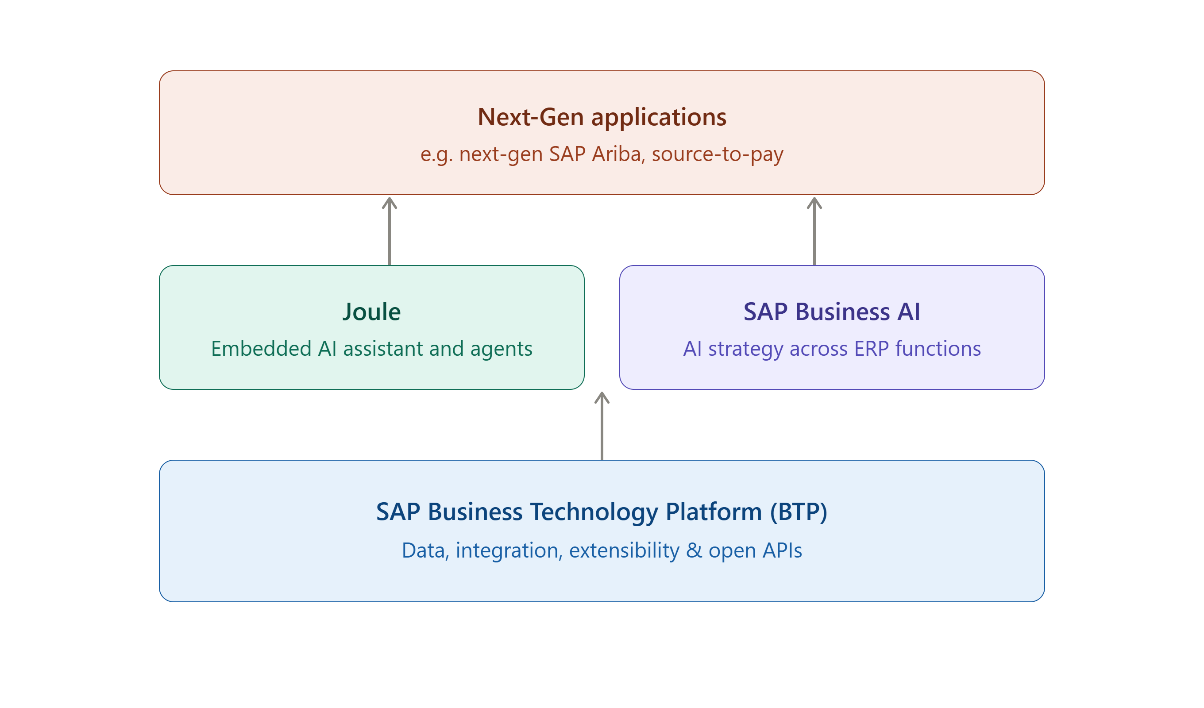
With the reorg, the pieces that make Next-Gen work are formally part of the same organization. Here’s what each one does:
SAP Business Technology Platform (BTP) is the foundation everything else sits on — now folded into Herzig’s broader Business AI Platform org. It’s SAP’s unified, cloud-native layer for integration, data, and extensibility, giving Next-Gen applications open APIs, real-time data consistency, and the ability to connect cleanly with SAP S/4HANA and third-party systems, instead of relying on legacy point-to-point integrations.
Joule is SAP’s AI assistant and agent layer, embedded directly into workflows rather than living in a separate chat window. Swaminathan has described the ambition as reimagining Joule “from a natural language chat client interface towards a new engagement layer” — the way people interact with SAP software going forward. In next-gen Ariba specifically, Joule already handles invoice capture, contract summarization, supplier risk analysis, and bid comparison, and SAP is expanding it toward agentic use cases like a Bid Analysis Agent and an Intake Management agent moving toward general availability.
Joule Studio 2.0 now gives customers and partners lifecycle tools to design, build, and govern their own custom agents — in one Sapphire demo, it took a detected pricing issue worth an estimated $24 million in margin impact and generated a requirements document, technical spec, and orchestrated agent workflow to fix it.
SAP Business AI is the strategy layer tying this together — embedding AI across finance, procurement, production, and supply chain to drive measurable outcomes, developed in partnership with companies like LG CNS on AI-driven ERP transformation, and now a core pillar of the Business AI Platform itself.
Why It Matters: The Benefits
- Unified data, fewer silos. A single supplier “source of truth” across sourcing, contracts, buying, and invoicing eliminates the reconciliation work that plagued legacy Ariba — and the same Knowledge Graph/Business Data Cloud approach extends this across finance, HR, and CX under the Autonomous Suite.
- Faster, better decisions. AI-generated supplier summaries, risk analysis, and bid comparisons shift teams from manual evaluation to AI-assisted judgment calls — reflected in the real-world invoice cycle and reconciliation gains cited above.
- Open, modern architecture. BTP’s open APIs make it far easier to connect Next-Gen apps with S/4HANA and non-SAP systems than it was on the old stack.
- Faster deployment. Low-code/no-code setup and trial environments let businesses stand up end-to-end processes quickly without sacrificing security.
- Built-in governance and risk visibility. Enhanced 360° supplier profiles now include sustainability tracking and centralized governance for supplier actions, echoing the governance layer SAP has built into the Business AI Platform itself.
- No forced migration. Existing Ariba customers aren’t required to jump immediately — SAP is delivering next-gen capabilities incrementally, so organizations can adopt at their own pace.
How to Prepare: A Practical Approach
Getting ready for Next-Gen AI on BTP is less about flipping a switch and more about groundwork. Here’s a sensible sequence:
1. Assess your current landscape. Understand your existing SAP Ariba (or ERP) footprint, licensing position, and how BTP-ready your environment already is. Readiness depends heavily on what you’re running today.
2. Clean up your master data first. Vendor, customer, and material master data quality directly determines how well AI agents perform. Garbage in, garbage out applies doubly to AI-driven procurement — a master data quality assessment should come before scaling Joule agents.
3. Provision and set up BTP. Enablement typically follows a structured path: application provisioning through the SAP for Me portal, joint BTP setup between SAP and the customer, and identity/authentication setup via SAP Cloud Identity Services.
4. Plan licensing carefully. Next-gen Ariba itself doesn’t require new licensing, but premium agentic AI features may run on separate bundles and consume additional SAP AI credits — budget for this distinctly from your core license.
5. Pilot before you scale. Start with a contained use case — invoice capture, contract summarization, or bid analysis — to build internal confidence and surface data or process gaps before wider rollout.
6. Build internal AI fluency. Encourage teams to get hands-on with Joule prompts and, where relevant, Joule Studio, so the organization isn’t dependent on a small group of specialists to extract value.
7. Track the roadmap. SAP is now shipping on a quarterly release cadence for next-gen Ariba, with new agentic capabilities arriving every few months and a commitment to back-port a majority of them to current-generation environments. With the Business AI Platform and Autonomous Suite now under dedicated leadership, expect that cadence to accelerate rather than slow down.
How NexCen Can Help You Get Ready
Most of the groundwork above — landscape assessment, master data cleanup, BTP setup, licensing decisions — is exactly where organizations get stuck without the right partner. This is where NexCen Global comes in.
NexCen brings deep, hands-on SAP expertise across S/4HANA, BTP, and application management services, and can support your Next-Gen readiness at each stage:
- Landscape assessment. NexCen analyzes your current on-premise or cloud SAP environment, benchmarks it against Next-Gen/BTP prerequisites, and sizes what a move actually requires — so you know exactly where you stand before committing budget.
- Master data readiness. Through its automation and data analytics practice, NexCen helps clean, standardize, and validate vendor, customer, and material master data — the foundation Joule and other AI agents depend on to perform well.
- BTP and cloud migration. With a dedicated Cloud Migration practice (readiness assessments, migration planning, infrastructure sizing, and platform migration across Azure, AWS, and GCP), NexCen can handle the technical heavy lifting of standing up your BTP foundation.
- Automation to free up capacity. NexCen’s RPA solutions can automate manual, repetitive processes in 6–12 weeks — reducing workload by 25–65% and freeing your team to focus on the higher-value work AI agents are meant to support, not compete with.
- Ongoing Application Management Services (AMS). Beyond go-live, NexCen’s AMS model covers 24/7 support, performance tuning, and continuous optimization, so your Next-Gen environment keeps pace with SAP’s quarterly release cadence instead of falling behind it.
- Center of Expertise. NexCen’s SAP Center of Expertise offers training, certification support, and best-practice guidance to build internal AI and BTP fluency across your team, not just at the consultant level.
Next Steps
If you’re weighing a move to Next-Gen SAP Ariba or a broader BTP-based AI strategy, here’s a realistic starting point:
- Request a readiness assessment. Get an objective view of your current SAP landscape, licensing position, and data quality before setting a timeline.
- Prioritize one pilot use case. Pick a single, high-friction process (invoice capture, contract review, or bid analysis) to prove value early.
- Set a data cleanup sprint. Treat master data quality as a prerequisite milestone, not a parallel workstream.
- Engage a partner who can execute end-to-end. From assessment through migration, automation, and ongoing support — a partner like NexCen can shorten the path from “interested” to “live.”
- Talk to NexCen. Reach out at atul@nexcenglobal.com to scope a readiness assessment or pilot for your organization.
The Bottom Line
SAP’s July 2026 reorg wasn’t just a management shuffle — it’s the organizational expression of a strategy that’s been building since Sapphire: a unified Business AI Platform under Herzig, and an Autonomous Suite under Swaminathan, both aimed at the same destination, the Autonomous Enterprise. Next-Gen SAP Ariba, BTP, and Joule are how that strategy shows up in your day-to-day procurement and finance processes right now. For procurement and IT leaders, the opportunity is real: cleaner data, faster decisions, and genuinely AI-assisted workflows, backed by outcomes SAP customers are already reporting. But the payoff depends on doing the unglamorous prep work — landscape assessment, master data cleanup, and a clear-eyed pilot — before scaling AI agents across the business.
What’s your organization’s take — are you planning an early move to Next-Gen SAP Ariba, or waiting for the Autonomous Enterprise roadmap to mature? Drop your thoughts below.