
Why Oracle Cloud Testing Requires Specialized Automation
Unlike conventional web applications, Oracle environments operate across deeply integrated business processes. A small change in procurement, finance, HR, or supply chain workflows can create cascading effects across multiple modules and systems.
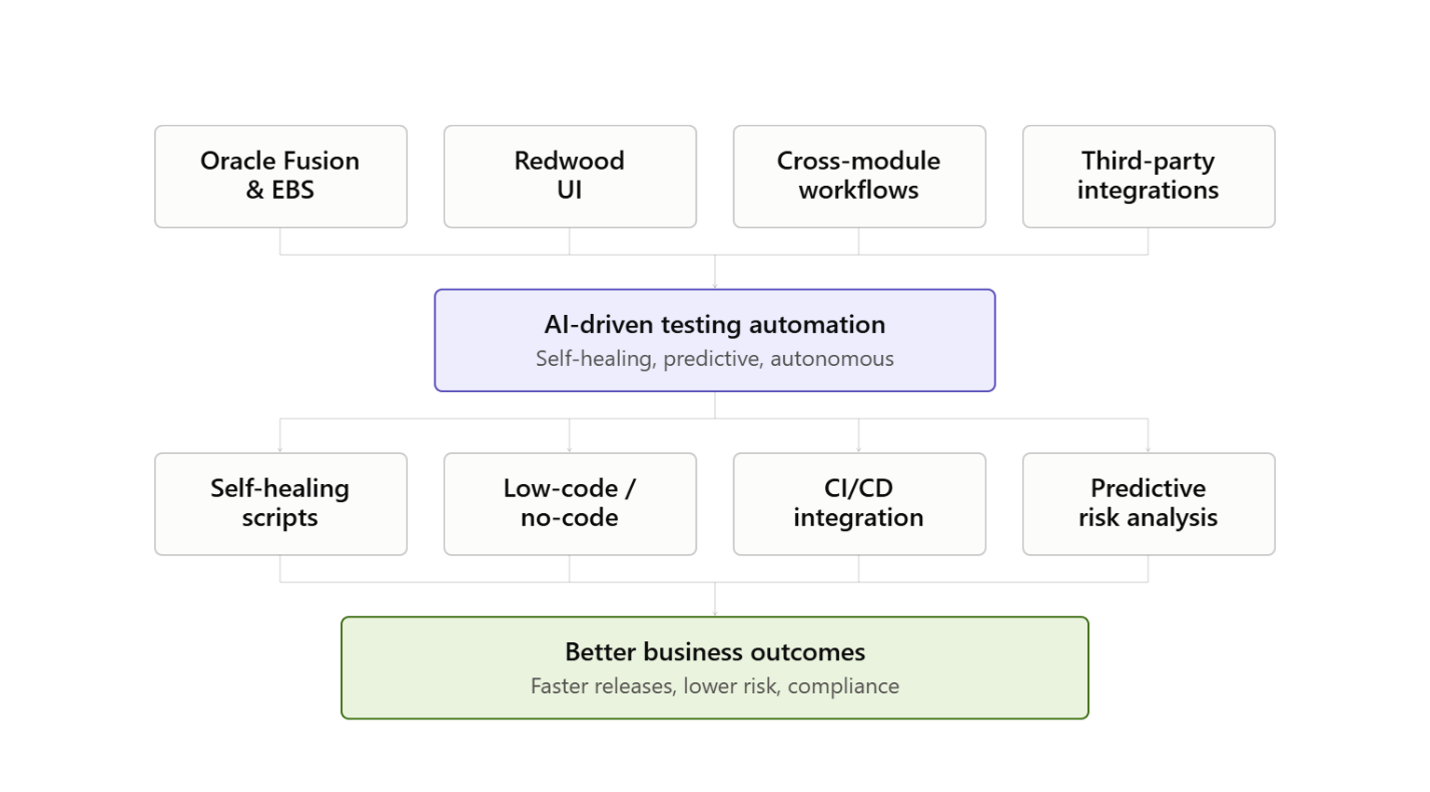
Modern Oracle testing must address challenges such as:
- Quarterly Oracle Cloud updates and patches
- Redwood UI and dynamic component handling
- Cross-module process dependencies
- Hybrid Oracle EBS + Fusion environments
- Third-party integrations with Salesforce, ServiceNow, SAP, and custom APIs
- Compliance, auditability, and traceability requirements
- Faster Agile and DevOps-driven release cycles
As enterprise ecosystems evolve, organizations need automation frameworks that reduce script maintenance while increasing test resilience and business process coverage.
Key Features Enterprises Should Look For
Before selecting an Oracle Cloud testing platform, enterprises should evaluate solutions based on the following capabilities:
1. Oracle Fusion & Redwood UI Support
Modern Oracle interfaces use dynamic elements and responsive layouts that generic automation tools often struggle to identify consistently.
2. Self-Healing Automation
AI-driven maintenance helps reduce test failures caused by UI or locator changes after Oracle quarterly updates.
3. End-to-End Business Process Validation
Testing should extend beyond screens and transactions to validate real enterprise workflows across ERP, HCM, SCM, APIs, and external systems.
4. CI/CD & DevOps Integration
Testing platforms must integrate seamlessly with Jenkins, Azure DevOps, GitHub Actions, and modern release pipelines.
5. Low-Code or No-Code Automation
Business analysts and functional users increasingly participate in testing. Visual or low-code frameworks help scale automation without deep programming expertise.
6. Cross-Platform Testing
Modern Oracle ecosystems often involve web, mobile, APIs, desktop apps, and external integrations requiring unified automation coverage.
Leading Oracle Cloud Testing Tools in 2026
1. Selenium
Selenium remains one of the most widely used automation frameworks globally. Its open-source nature provides flexibility and complete customization for technically mature QA teams.
Best suited for:
- Developer-heavy QA teams
- Custom automation frameworks
- Organizations needing full scripting control
Strengths:
- Extensive community support
- Multi-language compatibility
- Strong CI/CD ecosystem integration
- Flexible cross-browser automation
Considerations:
Selenium often requires higher maintenance in Oracle environments with dynamic locators and evolving UIs. Teams typically need significant framework engineering expertise to manage Oracle-specific complexities effectively.
2. Tricentis Tosca
Tricentis Tosca is widely adopted among large enterprises for model-based testing and enterprise-scale automation.
Best suited for:
- Large enterprises
- Regulated industries
- Complex enterprise ecosystems
Strengths:
- AI-assisted automation
- Strong Oracle and SAP integration support
- Risk-based testing capabilities
- End-to-end enterprise process validation
Considerations:
The platform offers extensive enterprise functionality but may involve higher licensing and implementation costs compared to lightweight alternatives.
3. Opkey
Opkey is a specialized Oracle-certified automation solution designed specifically for ERP testing.
Best suited for:
- Oracle Cloud ERP environments
- Enterprises with frequent patch testing requirements
- Business-user-driven automation
Strengths:
- Thousands of prebuilt Oracle test cases
- AI-powered automation
- One-click patch validation
- No-code framework
Considerations:
Opkey’s Oracle specialization makes it highly effective for organizations prioritizing rapid Oracle update validation and simplified automation adoption.
4. Test Evolve
Test Evolve focuses on Agile-native automation with strong support for modern Oracle Cloud environments and CI/CD workflows.
Best suited for:
- Agile delivery teams
- Continuous testing environments
- Hybrid Oracle ecosystems
Strengths:
- Support for Redwood UI
- Self-healing automation
- API, UI, and cross-platform testing
- Integration with GitHub, Jenkins, BrowserStack, and Azure DevOps
- Strong reporting and analytics capabilities
Considerations:
The platform is particularly attractive for organizations looking to accelerate Oracle release cycles while maintaining continuous regression coverage.
5. ACCELQ
ACCELQ offers cloud-based automation designed for Agile and DevOps ecosystems.
Best suited for:
- API-heavy Oracle environments
- Agile enterprises
- End-to-end integration testing
Strengths:
- Autonomous automation maintenance
- Dependency mapping
- Collaborative test design
- Unified API and UI testing
Considerations:
ACCELQ performs well in environments where Oracle systems integrate extensively with third-party applications and services.
6. Leapwork
Leapwork emphasizes visual, flowchart-based automation for business-friendly test creation.
Best suited for:
- Non-technical QA users
- Business-driven automation initiatives
- Regulated enterprise environments
Strengths:
- Visual drag-and-drop automation
- Reusable workflows
- Live debugging
- Cross-platform support
Considerations:
Leapwork helps organizations democratize automation by enabling broader participation from business teams without heavy coding dependencies.
Choosing the Right Oracle Testing Strategy
No single testing platform is universally ideal for every Oracle environment. The right solution depends on several organizational factors:
- Existing QA maturity
- Oracle ecosystem complexity
- Internal technical expertise
- Budget and licensing models
- Compliance requirements
- CI/CD adoption levels
- Migration roadmap from EBS to Fusion
- Cross-platform integration needs
Organizations with large enterprise landscapes may prioritize scalability and governance, while Agile teams may focus more on speed, low maintenance, and continuous delivery integration.
The most successful Oracle testing programs typically combine:
- Automated regression coverage
- API validation
- Business process testing
- Continuous monitoring
- AI-assisted maintenance
- CI/CD pipeline integration
Final Thoughts
Oracle Cloud modernization continues to accelerate across enterprises worldwide. However, as systems become more interconnected and release cycles become faster, testing can no longer remain reactive or heavily manual.
Modern Oracle Cloud testing platforms help organizations reduce operational risk, improve release confidence, and maintain business continuity despite continuous platform evolution.
Whether an enterprise prioritizes no-code automation, AI-driven maintenance, CI/CD integration, or deep enterprise process validation, selecting the right Oracle testing tool can significantly improve release reliability and operational efficiency.
As Oracle ecosystems continue evolving in 2026 and beyond, organizations that invest in scalable, intelligent testing automation will be far better positioned to deliver faster innovation with lower risk.
The Growing Role of AI in Oracle Cloud Testing
Artificial Intelligence is rapidly transforming the way enterprises approach Oracle Cloud testing. Traditional automation frameworks primarily focused on scripted execution and regression validation. However, modern AI-powered testing platforms are moving far beyond simple automation.
AI is now enabling testing systems to become adaptive, predictive, and increasingly autonomous.
How AI is Changing Oracle Testing
1. Self-Healing Test Automation
One of the biggest challenges in Oracle Cloud environments is frequent UI and workflow changes introduced through quarterly updates. AI-powered testing tools can automatically detect locator changes, update scripts dynamically, and reduce test maintenance efforts significantly.
This minimizes downtime and improves regression stability.
2. Intelligent Test Case Generation
AI can analyze business processes, user journeys, historical defects, and application behavior to automatically recommend or generate optimized test scenarios.
Instead of manually creating thousands of scripts, enterprises can now accelerate automation coverage with AI-assisted test creation.
3. Predictive Risk Analysis
Advanced AI models can identify high-risk business areas based on:
- Historical production issues
- Change impact analysis
- Usage patterns
- Integration dependencies
- Release frequency
This allows QA teams to prioritize testing efforts intelligently rather than executing large, time-consuming regression suits blindly.
4. Autonomous Defect Detection
Modern AI testing platforms increasingly use machine learning to identify anomalies, performance degradation, UI inconsistencies, and integration failures automatically.
This improves defect discovery speed while reducing dependency on manual validation.
5. Natural Language Test Automation
Low-code and no-code platforms are now integrating generative AI capabilities that allow users to create automation scripts using simple business language.
For example: "Validate employee onboarding workflow from recruitment to payroll activation."
AI can translate such instructions into executable automation flows, dramatically improving accessibility for business users and functional consultants.
The Future of AI-Driven Enterprise Testing
The future of Oracle Cloud testing is expected to evolve toward fully intelligent quality engineering ecosystems where AI continuously monitors, tests, predicts, and optimizes enterprise applications in real time.
Over the next few years, enterprises are likely to see:
Autonomous Testing Systems
AI agents are capable of independently creating, executing, repairing, and optimizing test cases without significant human intervention.
Continuous Quality Intelligence
Testing platforms will move from reactive validation to proactive business risk prediction by analyzing production telemetry, user behavior, and release patterns.
Hyper-Personalized Testing
AI will dynamically tailor testing strategies based on organization-specific business processes, industry compliance requirements, and application usage trends.
Integrated AI Agents Across DevOps
Testing AI agents will increasingly collaborate with development, security, monitoring, and deployment agents inside enterprise DevOps ecosystems.
Faster Oracle Release Adoption
Organizations using AI-driven testing frameworks will be able to adopt Oracle quarterly updates significantly faster with lower operational risk and reduced validation cycles.
AI Will Redefine Quality Engineering
The role of QA teams is also evolving. Future testing organizations will shift from primarily executing manual validation toward:
- AI governance
- Quality strategy
- Risk analytics
- Business process assurance
- Intelligent automation orchestration
Rather than replacing QA professionals, AI is expected to augment teams by eliminating repetitive activities and enabling greater focus on strategic quality initiatives.
Enterprises that adopt AI-powered testing early will likely gain significant advantages in release speed, operational stability, scalability, and digital transformation readiness.